

Your brand design could be costing you revenue as your competitors invest in establishing themselves as the authority in your sector. Your brand must reflect authority, value and trust so that you set yourself above your competitors.
A simple 15-minute discovery call will confirm how we can assist your website or brand design, with a strategy to help you grow and thrive.
Walk across the tech spaces of LinkedIn or X right now, and you will see the same triumphant claim over and over again: "I built this entire website using nothing but a single text prompt." The rise of "Vibe Coding"—the process of using Large Language Models (LLMs) like Claude or front-end generators like Bolt to write thousands of lines of raw code from plain English descriptions—has completely altered the digital landscape. To the non-technical founder running a 7-figure service business, this looks like the ultimate liberation. The middleman has been cut out. Custom software design has seemingly been commoditised.
But there is a massive difference between building a digital prototype that looks impressive in a screen recording and deploying a secure, high-converting revenue engine that protects your brand's reputation.
For high-ticket authorities, relying on pure, unmanaged AI code is not an innovation. It is an operational liability.
The Reality Under the Hood: What is "Spaghetti Code"?
When an AI model generates a website, it focuses entirely on the visual presentation tier—the front-end interface that humans see. It writes code that satisfies the immediate requirements of your text prompt.
However, AI models do not write code with a long-term architecture plan. They create what software engineers call "spaghetti code"—a tangled, deeply nested web of logic that operates successfully today but is incredibly fragile under pressure. Because the AI does not have contextual awareness of your server environment, future browser updates, or cross-platform dependencies, a single structural shift can cause the entire system to collapse.
If your business relies on booking high-ticket clients, your website cannot afford to be an experimental science project. It needs to be an industrial-grade infrastructure.
The Three Critical Weaknesses of Pure AI-Generated Sites
Before you abandon managed infrastructure for the novelty of raw AI code, you must understand the long-term operational taxes that come with self-hosted web applications.
1. The Missing Content Management System (CMS)
When an AI engine codes a website, it builds a static file structure. It does not build an editor interface. This means that if you want to alter a single word in a headline, update a case study image, or post a new article to your blog, you cannot simply log into a dashboard and click "Edit."
Instead, you or your team must dive back into the source code, rewrite the raw files, or pass the code back into an AI prompt window, hoping the model doesn't break a different layout element while making the adjustment. A business scaling toward multiple seven figures cannot allow its marketing agility to be bottlenecked by source-code updates.
2. The Security & Vulnerability Gap
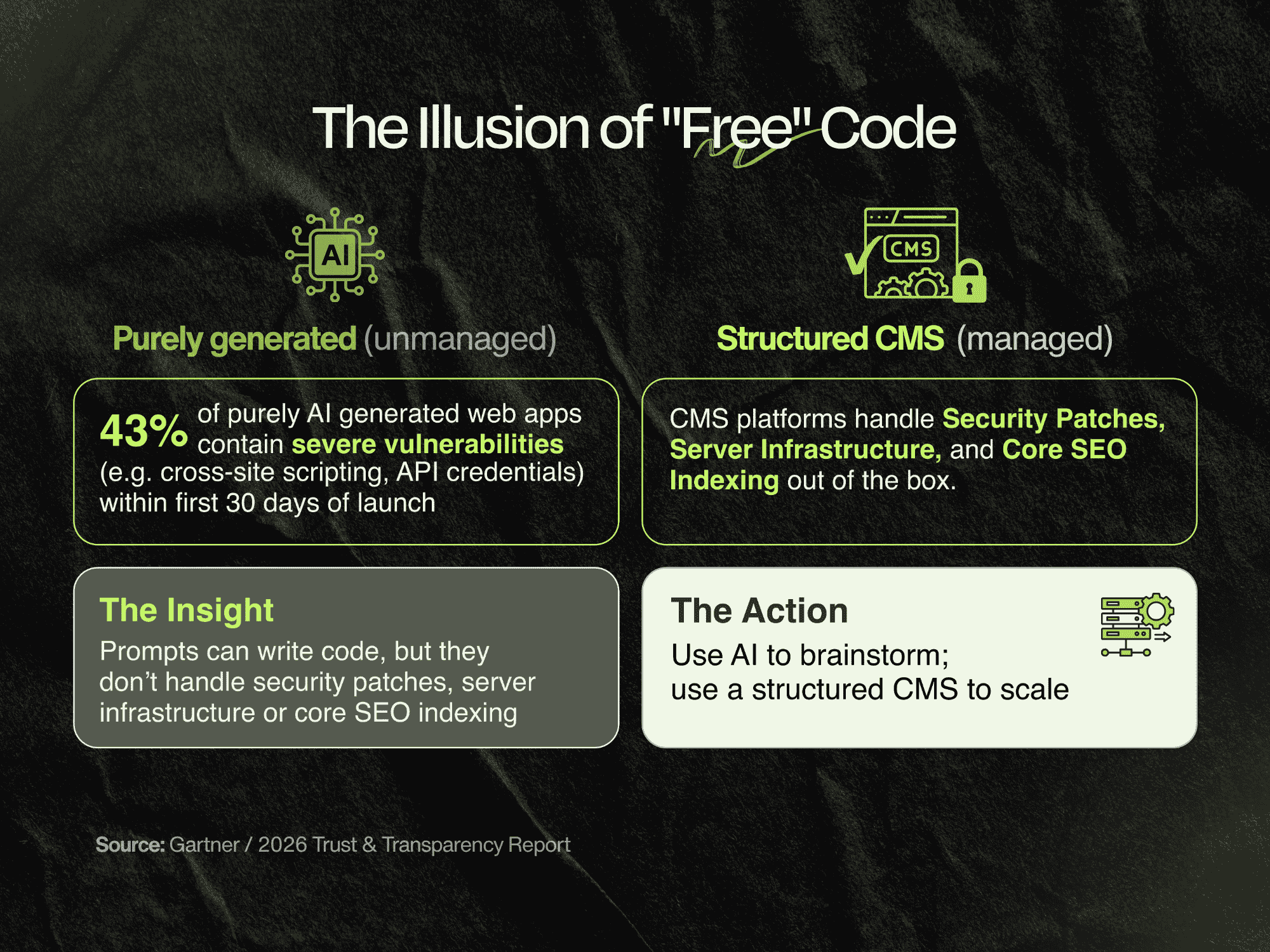
AI models train on existing web data, which means they frequently replicate outdated coding patterns or known security exploits. Independent security audits of purely AI-generated, self-hosted web applications show that over 40% of vibe-coded platforms contain severe security flaws right out of the box—ranging from cross-site scripting (XSS) vulnerabilities to exposed API endpoints.
When you use a managed framework, security patches are deployed automatically at the server level. When you use raw AI code, you are your own systems administrator. If a security vulnerability is exploited, the financial and reputational fallout falls entirely on your shoulders.
3. The Manual Hosting & Server Burden
An AI tool will give you a repository of files, but it will not host them. You have to manually deploy those files onto cloud servers like AWS, Vercel, or Netlify.
If your server goes offline at 2:00 AM due to a hosting certificate error or a high-traffic spike, there is no support team to call. Your website simply displays a blank error screen to potential clients until you manually diagnose and fix the infrastructure code.
Why Structured Frameworks (Like Squarespace) Win the Strategic Game
At Saf Designs Studio, we treat AI as a powerful engine for creative brainstorming and rapid interface prototyping. But when it comes to constructing an actual High-Ticket Conversion Architecture, we explicitly anchor our client systems in enterprise-grade managed platforms like Squarespace.
For an authority-driven business, a managed CMS provides distinct strategic advantages that raw code simply cannot replicate:
Managed Technical SEO Guards
True search and AI engine optimisation requires flawless technical execution. Platforms like Squarespace handle your clean URL mapping, automatic XML sitemap generation, schema markup inputs, and global SSL encryption right out of the box.
To get the same result with raw AI code, you must perfectly prompt for technical SEO nuances that most non-technical founders aren't even aware exist. If your AI code misses a single canonical tag link, your visibility in search results can plummet.
Zero-Maintenance Engineering
As web browsers update their rendering engines, website code must adapt. Managed ecosystems handle these global web standard updates invisibly behind the scenes. Your site remains fast, stable, and secure without requiring you to hire a developer to update your legacy code framework every six months.
Absolute Operational Autonomy
A premium brand requires speed. If an elite lead requests an immediate structural shift in your messaging, your team needs the autonomy to log into a secure, intuitive visual interface and make that shift in seconds. A structured CMS protects your time, allowing you to focus on high-level market positioning rather than code debugging.
Conclusion: Build for Longevity, Not the Vibe Check
Code has officially become a commodity. Anyone can generate an interface in thirty seconds, but very few can build a secure, sustainable digital asset that consistently builds trust with elite buyers.
Do not let the short-term novelty of a "cool prompt" compromise the security, reliability, and organic visibility of your brand. Use AI for your imagination, but use a verified, managed infrastructure for your business engine.
Is Your Digital Infrastructure Built on Quicksand?
If your website is running on fragile, unmanaged custom code or an insecure legacy setup, you are risking your brand's authority with every single click.
This month, I am opening exactly two spots for our comprehensive Infrastructure & Conversion Layout Audit.
We will deep-dive into your existing digital system, identify the technical trust leaks that are alienating high-ticket clients, and map out a bulletproof transition to a premium, managed Squarespace system that your business can actually scale with.
